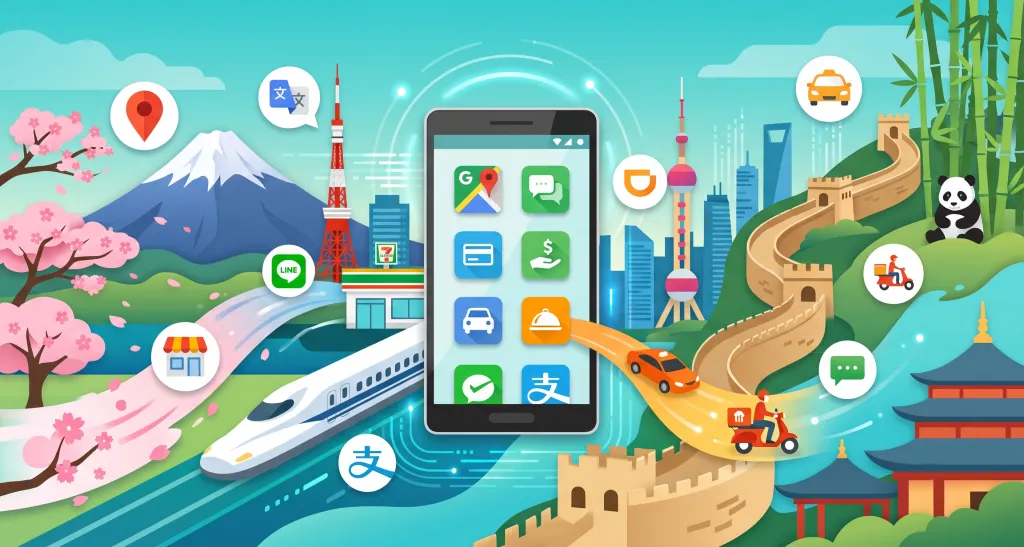
When living and working in China or Japan as an expatriate, one of the key concerns is the set of “apps” you use on a daily basis.
However, since each country has its own unique culture and customs, the apps used on PCs and smartphones naturally differ as well.
In this article, we have compiled a quick-reference comparison table, from our company’s perspective, highlighting some of the most useful apps for daily life and work—aimed at expatriates stationed in both China and Japan.

When Japanese companies (or Japanese expatriates) begin living and working in China, one of the first things they notice is that the apps commonly used there are completely different from those popular in Japan and other overseas countries.
There are numerous apps with China‑specific ecosystems, such as WeChat and Alipay, which function as essential infrastructure for daily life and work in China.
For example, taking trains and buses, hailing taxis, paying at restaurants, settling utility bills, booking hospital appointments, online shopping, and searching for information—all of these can be done entirely via a smartphone and apps.
In other words, without these apps, life and work in China would simply not be possible.

On the other hand, the app environment in Japan is vastly different from that in China, featuring a unique structure with a wide variety of apps coexisting.
In Japan, US‑origin apps such as Google, Amazon, YouTube, and X hold a significant share, and in the fields of information search, video content, social media, and online shopping, these platforms have become the de facto standards.
At the same time, Chinese‑origin apps like TikTok and WeChat are steadily expanding their user base and scope of use, making them increasingly indispensable in Japanese daily life and work as well.
Furthermore, messaging app LINE, payment service PayPay, and e‑commerce platforms like Rakuten and Mercari continue to enjoy strong support from users as everyday essentials.
As a result, since various apps coexist in Japan, it may take a little time for Chinese companies (or Chinese expatriates) to get used to this “app switching” when living and working in Japan.
This is a mutually corresponding quick reference table that allows expatriates in both China and Japan to compare and understand the apps at a glance.
Please use it as a reference for your everyday app usage.
| App Category | Major Apps Used in China | Major Apps Used in Japan |
| Search Engines | ・Baidu ・360 Search ・Bing |
・Google Search ・Yahoo! Search ・Bing |
| Messaging Apps | ・LINE | |
| SNS (Information / News) | ・X | |
| SNS (Video Content) | ・Bilibili ・Douyin |
・YouTube ・TikTok |
| SNS (Lifestyle) | ・RED (Xiaohongshu) | ・Instagram |
| Movies / Dramas / Anime | ・Bilibili ・Youku ・iQiyi ・Tencent Video |
・YouTube ・Netflix ・Amazon Prime Video ・ABEMA TV |
| App Platforms | ・Platforms provided by Android smartphone manufacturers ・App Store |
・Google Play ・App Store |
| Mobile Payment | ・Alipay ・WeChat Pay |
・PayPay |
| E‑Commerce | ・Taobao ・JD.com ・induoduo ・Douyin |
・Amazon.co.jp ・Rakuten ・Yahoo! Shopping ・AliExpress ・Temu |
| Flea Market Apps | ・Xianyu | ・Mercari ・Yahoo! Auctions |
| Map Apps | ・Amap ・Baidu Maps |
・Google Maps ・NAVITIME |
| Ride‑Hailing Apps | ・DiDi | ・GO ・Uber Taxi ・DiDi |
| Local Information / Reviews | ・Dianping ・Meituan |
・Tabelog ・GURUNAVI |
| Food Delivery | ・Meituan Waimai ・Taobao Flash Shopping |
・Uber Eats ・Demae‑can |
| Job Hunting Apps | ・Boss Zhipin ・Zhaopin ・51job ・Liepin |
・Indeed ・Rikunabi NEXT ・Townwork |
| Translation Apps | ・Youdao Dictionary ・Baidu Translate |
・Google Translate |
| Language Learning Apps | ・Duolingo ・HelloTalk |
・Duolingo ・HelloTalk |
| Mobile Carriers | ・China Telecom ・China Mobile ・China Unicom |
・NTT docomo ・KDDI (au) ・SoftBank |
| Travel Booking (Overseas / Domestic) | ・Ctrip | ・Trip.com |
| Logistics / Delivery | ・SF Express ・ZTO Express ・YTO Express ・STO Express |
・Yamato Transport (Kuroneko) ・Sagawa Express ・Japan Post (Yu‑Pack) |
| High‑Speed Rail Tickets | ・Railway 12306 | ・SmartEX |
| Public Transit Boarding Apps | ・Alipay / WeChat boarding codes (e.g., “Chengche Ma”) | * There are linked apps based on IC cards |
| Delivery Lockers | ・Fengchao | * Not widely used as an app (mainly building‑installed lockers) |
| App Category | Major Apps Used in China | Major Apps Used in Japan |
| Integrated Business Platforms | ・WeCom ・DingTalk |
・Microsoft 365 ・Google Workspace |
| Document Creation / Office Software | ・WPS 365 | ・Microsoft 365 ・Google Workspace |
| Chat Tools | ・WeCom ・DingTalk |
・Slack ・Chatwork ・Microsoft Teams ・Google Workspace (Google Chat) |
| Web Email | ・Alibaba Mail | ・Google Workspace (Gmail) |
| Online Meetings | ・Tencent Meeting ・Ding Talk Meet ・WeCom Meet |
・Zoom ・Microsoft Teams ・Google Workspace (Google Meet) |
| Online Storage | ・Baidu Wangpan | ・Google Workspace (Google Drive) |
| Business Card Management | ・CamCard ・CamScanner |
・Eight ・Sansan |
| Online Contract Management | ・eSign | ・Docusign |
| Generative AI Tools | ・Deepseek ・Doubao ・Qwen |
・ChatGPT ・Google Gemini |
When stationed in both China and Japan, the apps you use in daily life and work may differ. The key is to embrace these differences flexibly and enjoy the change.
We hope this article helps enrich your daily life and business activities in both countries.
| Cloud Business System | https://beyond-shenzhen.cn/en/service/development |
| China Market Entry Solutions | https://beyond-shenzhen.cn/en/service/china-market-entry |
▼ WeChat Official Enterprise Account ▼

▼ Contact Inquiry Desk on WeChat ▼


 WeChat Official Account
WeChat Official Account
WeChat Inquiry Desk




 【2026】Public Holiday Calendar for China, Japan, & Singapore