
Japanese companies’ worries and challenges like these are not someone else’s problem.
- There are not enough workers on site
- Work quality is declining
- Infrastructure inspection work cannot keep up
Meanwhile, in the global physical AI robot field, China holds an overwhelming share.
As of January–June 2026, Chinese-made physical AI robots (smart robots) account for about 97% of global shipments, and China is described as being in a state of near-monopoly.
This article examines China’s world-leading “physical AI technology” from the perspective of how Japanese companies should use it and how they should combine it with their own strengths to address their challenges.
* Information as of September 2026
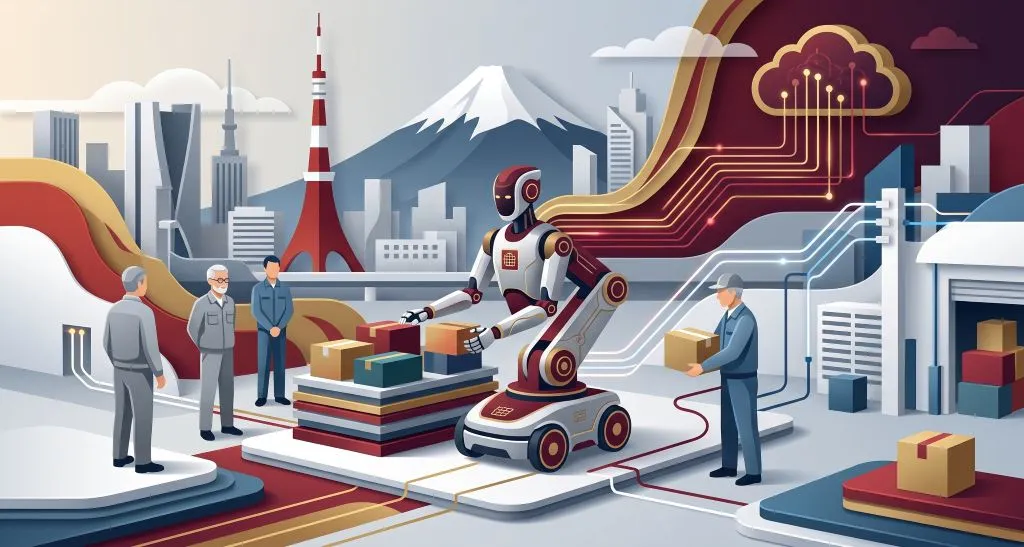
Before considering the use of China’s physical AI, let us first organize the situation and challenges that Japan faces.
Accurately understanding this part forms the foundation for answering the question, “Why should we now seriously consider Chinese technology?”
Japan’s working-age population (ages 15–64) peaked at about 87 million in 1995 and has continued to decline, falling to about 74 million in 2025. The proportion of the total population aged 65 or older has reached about 30%, making Japan one of the most aged societies in the world.
This impact is especially serious in construction, logistics, nursing care, and manufacturing. In the construction industry, for example, about 35% of workers are said to be 55 or older, and a wave of mass retirements will certainly arrive over the next 10 years.
In the logistics industry as well, triggered by the 2024 problem (strengthened overtime regulations for truck drivers), “not enough workers” has risen to the top of management challenges.
At Japanese worksites today, the issue is not “we want to replace people with robots,” but rather “we can no longer operate without robots.”
The labor shortage in Japan inevitably leads to higher labor costs. In fields with high job openings-to-applicants ratios, “labor shortage inflation,” in which workers cannot be hired even if wages are raised, has become the norm.
What weighs even more heavily is “social security costs.” In fiscal 2025, social security benefit payments reached about 140 trillion yen, accounting for about 30% of Japan’s general expenditures.
Spending on medical care, nursing care, and pensions continues to increase along with the aging population, and the burden on the working generation grows heavier year by year.
In other words, both “increasing the number of workers” and “lowering labor costs” have entered a phase in which they are structurally impossible. There is no way to solve this problem other than by drastically raising productivity.
Infrastructure in Japan, which received concentrated investment during the period of high economic growth, is now reaching its renewal period all at once. The greatest challenge is how to carry out inspection, maintenance, and repair with a continuously shrinking workforce.
Furthermore, delays in responding to technology are also serious. About 70% of Japanese companies respond that they are “working on DX (digital transformation) but are not seeing results,” and digitalization at the frontline level in particular lags far behind China.
Even when companies want to introduce new technology, voices such as “I don’t know where to start,” “We can’t secure a budget,” and “We don’t have the personnel” overwhelmingly dominate, especially among small and medium-sized enterprises.
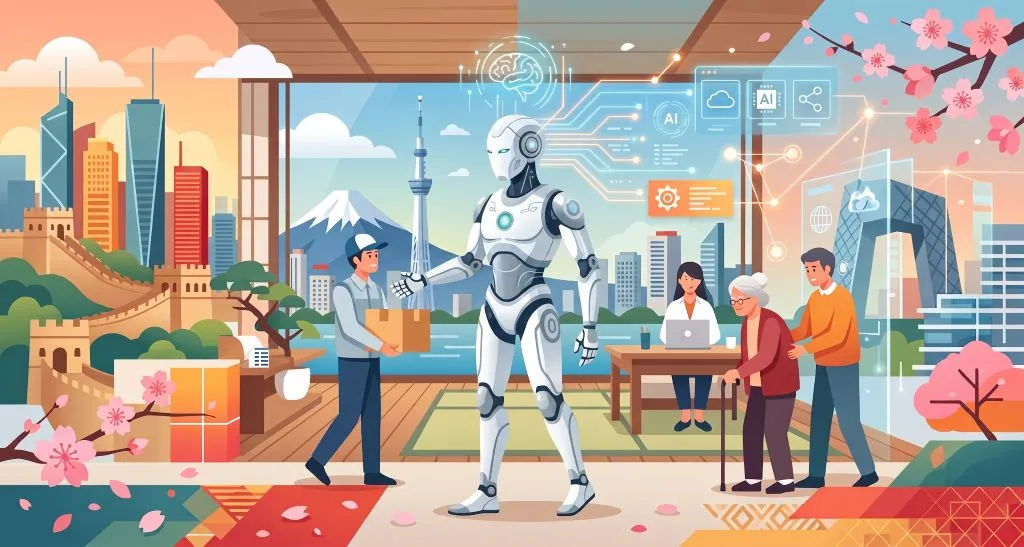
Due to the effects of Japan’s labor shortage and aging infrastructure described above, worksites in construction, logistics, medical care, infrastructure inspection, and other fields have entered a stage in which they can no longer function “without robots.”
What is expected in this context is Chinese physical AI robots. It can be said that there is high compatibility between “Japan’s domestic frontline challenges, which allow no delay” and “China’s hardware, which has overwhelming supply capacity.”
The introduction of Chinese-made physical AI robots has already begun in various parts of Japan.
In particular, the case at the University of Tsukuba Hospital is an ideal collaboration model that combines the excellent walking control technology of Chinese-made physical AI robots with the OS and application development capabilities of Japanese companies suited to frontline operations.
| Item | Overview |
| Airport (Ground Operations) | From May 2026, a demonstration experiment began at Haneda Airport to use humanoid robots for ground operations such as loading and unloading baggage and cargo and cleaning cabins.
Initially, the transport of cargo containers will be verified, and after demonstrations through the end of fiscal 2028, practical application is targeted for as early as fiscal 2029. |
| Logistics Warehouse | At logistics bases in Japan, a P0C (proof of concept) for physical AI robots was carried out.
Compatibility with item recognition, movement, and sorting tasks, as well as operability, safety, and work efficiency, were verified. Paid rental provision in the future is also being considered. |
| Medical Facilities | At the University of Tsukuba Hospital, a demonstration experiment was conducted in which a Japanese-made OS was installed on a physical AI robot.
Verification of autonomous walking within the hospital, obstacle avoidance, and guidance and transport tasks through conversation is said to have been fully completed. |
| Construction Sites | A major Japanese construction company conducted a demonstration experiment of patrol work by humanoid robots at a high-rise building construction site in Tokyo.
In parallel, verification is also progressing for painting work by robot arms that have learned by imitating workers’ movements. |
| Retail and Services | Serving robots are widely adopted at major Japanese restaurant chains.
By leaving serving to robots, the number of steps taken by store employees decreased by 42% before and after introduction, employment of people aged 65 and older doubled, and employment of people aged 70 and older increased sevenfold. |
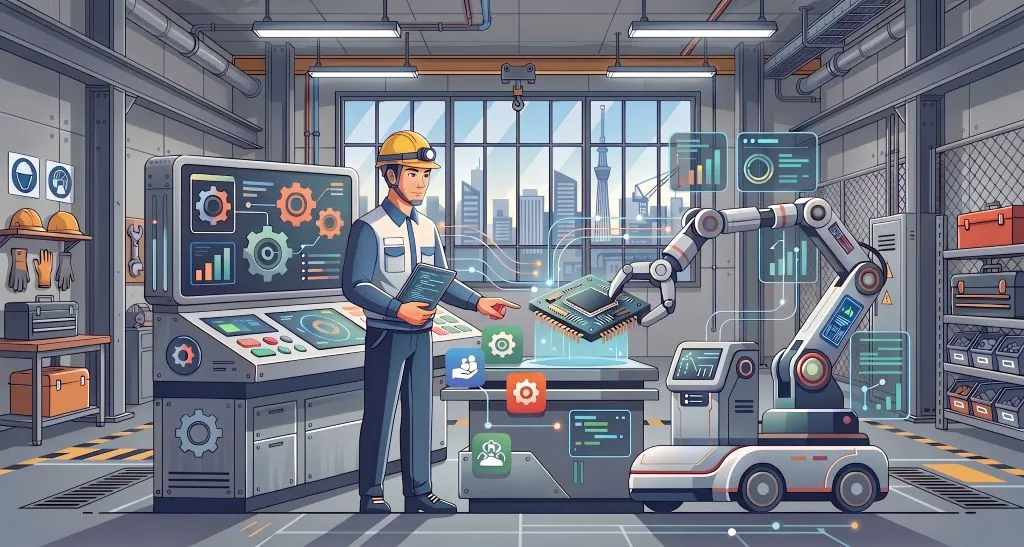
Software installed in Chinese physical AI robots is increasingly being developed in-house, but Japan’s precision control technology and frontline know-how are still values that Japan can proudly offer to the world.
While Chinese companies lead the world in walking control and mass-production technology, they recognize that there is much they should learn from Japanese companies in terms of “the ability to respond to customization” that meets the detailed needs of industrial worksites.
By combining “Chinese hardware × Japanese software × Japanese frontline know-how,” there is potential to create one of the world’s leading solutions.
According to experts’ forecasts, physical AI robots will reach a price range that allows return on investment in 2028–2030.
Japanese companies that begin the following preparations now are likely to gain an advantage in the next generation of competition.
When introducing physical AI robots, information security and data handling are points that should be organized in advance.
What is important here is the idea of “separated design of hardware and software” and the principle that “data should basically be stored in its own country.”
For example, just as “data collected by robots used in Japan is managed on servers within Japan,” it is fundamental for any system or technology introduced that data used in a country be stored in that country. Global companies around the world are adopting the concept of “data localization,” in which each country’s data is stored within that country.
What makes this concept possible is the separated design of hardware and software. With this model, it is possible to take advantage of the strengths of Chinese-made physical AI robots while storing data within Japan.
China’s physical AI is a material for solving Japan’s challenges.
What matters is whether Japan can achieve smooth “customization” that makes the most of its strengths while incorporating Chinese physical AI hardware.
The key point is how to harmonize Chinese technology with Japanese worksites and how to utilize it.
● Statistics Bureau of Japan: Population Estimates 2025
https://www.stat.go.jp/data/jinsui/pdf/202508.pdf
● Ministry of Land, Infrastructure, Transport and Tourism: Current Status and Future of Aging Social Infrastructure
https://www.mlit.go.jp/sogoseisaku/maintenance/02research/02_01.html
| China Market Entry Solutions | https://beyond-shenzhen.cn/en/service/china-market-entry |
For Website Development & WeChat Solutions
▼ WeChat Official Enterprise Account ▼

▼ Contact Inquiry Desk on WeChat ▼


 WeChat Official Account
WeChat Official Account
WeChat Inquiry Desk




 【2026】Public Holiday Calendar for China, Japan, & Singapore