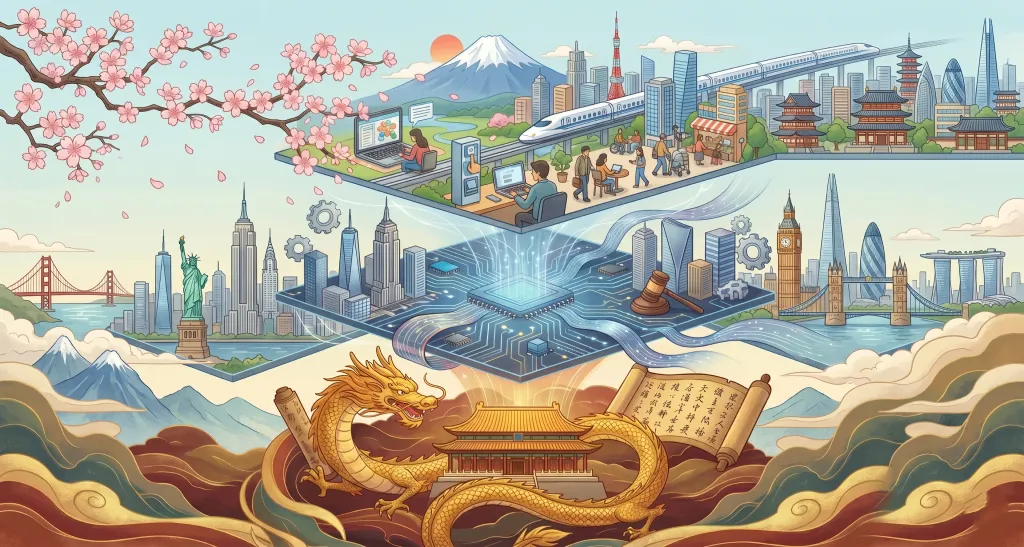
Chinese and Japanese cultures share many commonalities.
Among nations worldwide, Japan stand out as particularly prominent examples where Chinese culture remains deeply and daily permeated even in the modern era.
In this article, we will introduce Japan—a nation that has fused Chinese civilization with Western-style systems—by using the analogy of “Server Technology Layers.”
Chinese influence on systems, rituals, and food culture is vast and worldwide. This is a characteristic shared across many East and Southeast Asian nations.
Yet, even today, we believe “Kanji culture” remains the most significant Chinese-originated element permeating every aspect of Japanese culture, life, and business.
While China’s influence is broad, Kanji has played the most vital role in being continuously shared and forming the foundation of society to this day.
For instance, China and Japan share a unique advantage: meanings can be inferred through Kanji even without a shared spoken language. If Japanese were written only in Hiragana or Romaji, even natives would struggle to understand it quickly. Since each character carries its own meaning, both Chinese and Japanese speakers can achieve basic comprehension just by sight.
This shared cultural foundation creates a practical business advantage: relatively lower adaptation costs between China and Japan compared to Western or other foreign enterprises.
| Category | China | Japan | Overview |
| Kanji (Characters) | Sinosphere | Kanji Cultural Sphere | Japan adopted Kanji from China and developed it into a unique, domestic system. |
| Scripts | Simplified / Traditional | Jōyō Kanji (New Glyphs) | Although glyph shapes differ, the semantic core of the vocabulary remains the same. |
| Terminology | Travel, Management, Products, etc. | (Same as left) | High mutual readability; many modern technical and business terms are identical. |
| Calligraphy | Shufa / Official Inscriptions | Shodo / Official Inscriptions | Brush writing (Calligraphy) continues to function as both a fine art and a formal social ritual. |
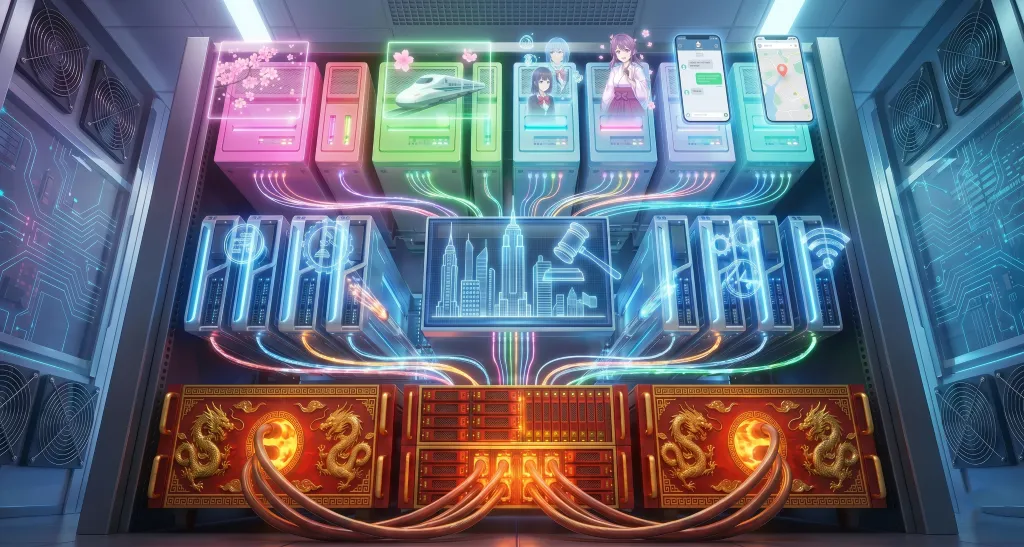
Japan has integrated Western-style systems upon a foundation of Chinese culture, actively adopting advanced technology while preserving its traditions.
While Japanese society may seem complex at first glance, it can be described through the perspective of an IT engineer as a structure resembling “Server Technology Layers” (OS, Middleware, and Applications).
| Server Technology Layer (3-Tier Structure) | Structure & Role | Country | Impact | Permeated Culture & Systems |
| ① OS (Infrastructure) | The foundation and “heart” that controls the entire PC or server.
* Examples: Windows, macOS, Linux, etc. |
China | Deep Spirit & Culture | ・Kanji that convey meaning visually ・High-context communication ・Relationships prioritizing social harmony ・Consciousness of seniority and roles ・Collective behavioral patterns |
| ② Middleware (The Bridge) | Backend mechanisms connecting the OS and Applications.
* Examples: Web servers (Apache/nginx), DB (MySQL), Programming languages (PHP). |
The West | Systems & Standards | ・Constitutional parliamentary system ・Market economy systems ・Modern accounting standards ・Western management theories ・IT standards |
| ③ Application (The Surface) | Software and apps used directly by users in daily life.
* Examples: Browsers, E-commerce, SNS, AI tools, Mobile apps. |
Japan | Operation & Adjustment | ・Improvement-ism (Kaizen) and Coordination-ism ・Precise service design and quality control ・High-fidelity creative content ・Unique business etiquette ・Katakana English and Japan-made English |
At the deepest core of the Japanese psyche lies an “OS (Operating System)” foundation, formed over millennia with Kanji culture at its heart.
This OS layer is rarely consciously perceived in daily life; however, everything from subtle daily thoughts to fundamental behavioral patterns operates upon this very base.
Furthermore, Kanji is not merely a writing system. It is a sophisticated script that visually compresses concepts and encompasses multi-layered meanings. As a result, Japanese communication naturally tends to be highly context-dependent (High-Context).
This OS serves as a “background process” constantly running within Japanese society, acting as the fundamental layer that supports the nation’s entire infrastructure.
Since the dawn of the modern era, Japan has rapidly integrated Western-style systems and standards.
This middleware layer acts as a bridge between the “OS (Deep Spirit & Culture)” and the “Application (Operation & Adjustment),” representing the social “rules” and “systems.” This includes the constitutional parliamentary system, market economy, modern accounting, management theories, and IT standards.
Crucially, however, Japan has installed and runs this middleware—which has a completely different design philosophy—directly on top of its existing OS. Instead of replacing or overwriting the cultural foundation of its OS, Japan has allowed these different architectures to coexist.
By installing and integrating these distinct “OS” and “Middleware” layers, Japan has created a “hybrid environment” operated in a uniquely Japanese form.
The unique Japanese “application” operates within a complex environment, where the “middleware” of systems and standards is adapted onto the cultural foundation of the “OS.”
Japan’s strength lies not in creating systems or standards from scratch, but in the ability to customize and thoroughly optimize imported mechanisms to suit the country’s needs.
By continuously layering processes of improvement and optimization while pursuing a unique UI/UX, Japan creates its own distinct style of operation and adjustment.
While this unique Japanese style is sometimes criticized as being “only valid within Japan,” it simultaneously serves as the source of overwhelming perfection and irreplaceable, unique value.
Because this Japanese social structure model is a hybrid environment integrating an OS and Middleware of fundamentally different designs, system specification and design conflicts can occur.
These are not defects of the OS or Middleware themselves, but rather characteristics that inevitably arise when connecting different architectures, often surfacing as phenomena that look like “glitches or bugs.”
Examples include the excessive peer pressure, inefficient meetings, slow consensus-building, and sluggish decision-making seen in Japanese society.
These can be interpreted as “distortions” at the interface, arising as a result of advanced optimization and customization within Japan’s unique application layer.
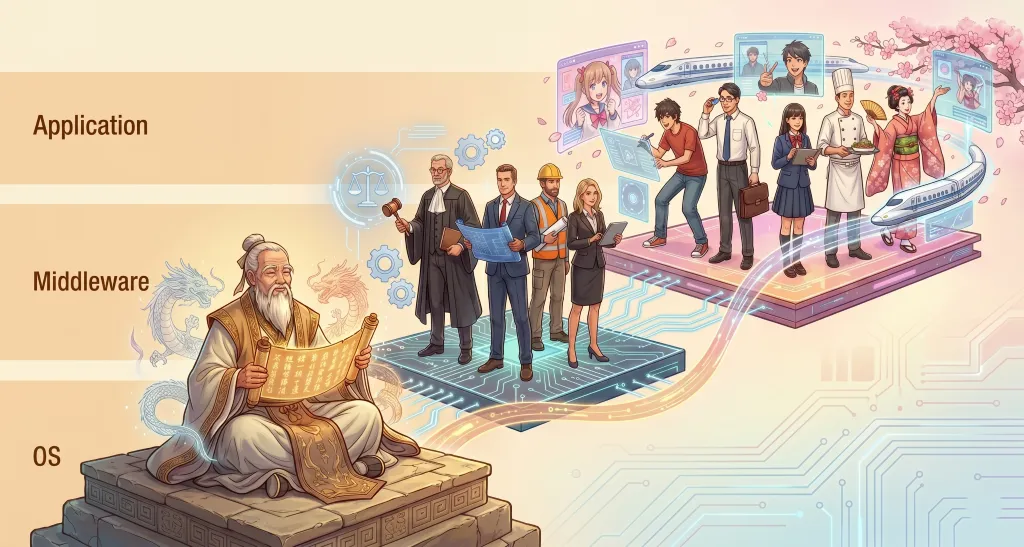
Japan is built upon a civilization foundation (OS) shared with China, implementing a separate lineage of Western-style systems (Middleware) on top of it, and expressing or operating unique Japanese content.
From this perspective, the cultures of China and Japan can be understood as structures derived from the same foundational core.
| China Market Entry Solutions | https://beyond-shenzhen.cn/en/service/china-market-entry |
| Hong Kong SAR IT Solutions | https://beyond-shenzhen.cn/en/service/hong-kong-solutions |
For Website Development & WeChat Solutions
▼ WeChat Official Enterprise Account ▼

▼ Contact Inquiry Desk on WeChat ▼


 WeChat Official Account
WeChat Official Account
WeChat Inquiry Desk



 【2026】Public Holiday Calendar for China, Japan, & Singapore