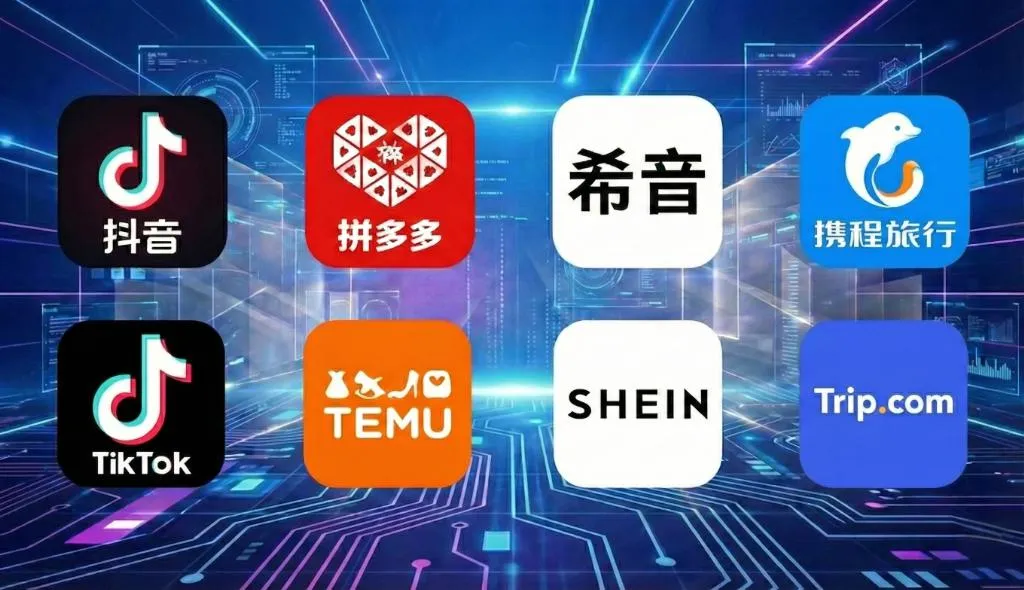
In our daily lives and work, we often find that globally recognized services actually originate from China.
For example, the Chinese short-video app “Douyin” operates globally as “TikTok.” When Chinese companies expand internationally, they thoroughly localize their brand names and visual identities to integrate into local markets. This localization is often so seamless that even domestic consumers fail to recognize them as Chinese brands.
This article categorizes these brands by industry to compare their domestic names with their global counterparts.
We hope this provides new insights for international readers and serves as a useful reference for those familiar with the Chinese market.
Table of Contents
When launching an internet business, securing a “BrandName.com” URL is a top priority.
However, using the pinyin of a Chinese name (e.g., Pinduoduo) often results in a URL that is too long, difficult to type, or already registered by a third party.
Therefore, when expanding overseas, companies create short, memorable, and globally unique coined words like “Temu.” This allows them to monopolize the temu.com domain, ensuring seamless global access.
Domain and trademark rights generally follow a “first-to-file” rule.
Even if a company wishes to use a well-known domestic name like “Ctrip” abroad, it legally cannot if a similar name is already registered in the target market.
To avoid this, companies strategically choose names with zero global litigation risk. For instance, acquiring globally recognized and secure trademarks like “Trip.com” has become a standard professional strategy.
The direct pronunciation of Chinese pinyin (e.g., Xiaohongshu) may be perceived as difficult to pronounce in certain cultural contexts.
By creating names like “TikTok” or “SHEIN”—which prioritize a modern, rhythmic sound over literal meaning—companies ensure their brands are readily embraced as trendy and “cool” by global consumers, regardless of their origin.
The following are key examples of Chinese products and services that operate under different identities in domestic and international markets.
We begin with mobile applications and web services.
When expanding globally, it is standard practice for Chinese apps to adopt “short and memorable” English names to better resonate with international users.
| Domestic Name | Global Name | Market Insights & User Impression |
| 微信(Weixin) | 【China】A “Super App” integrating work, mobile payments, and public services; it has become an essential digital infrastructure.
【Global】The standard tool for inbound payments. Registration for international users has become significantly more streamlined as of 2026. |
|
| 微博(Weibo) | 【China】The “Chinese X (formerly Twitter).” A high-speed information hub and the primary platform for official celebrity and corporate announcements.
【Global】An essential tool for tracking Chinese news and trends, particularly among international fans of Chinese entertainment. |
|
| 小红书(Xiaohongshu) | Little Red Book / RED | 【China】Often compared to Instagram, but primarily used as a powerful search engine for “authentic consumer reviews” rather than just visual aesthetics.
【Global】A trendsetting hub for “C-beauty” and lifestyle trends, highly popular among beauty-conscious demographics. |
| 抖音(Douyin) | TikTok | 【China】A lifestyle infrastructure where livestream e-commerce (“watch and buy”) is the absolute norm.
【Global】The epicenter of global youth culture and a dominant entertainment platform that dictates viral trends. |
| 快手(Kuaishou) | Kwai | 【China】 Dominant in lower-tier markets (regional cities and rural areas), characterized by strong social bonds between streamers and viewers.
【Global】A major competitor to TikTok, maintaining a strong presence in South America and Southeast Asia. |
These massive platforms support China’s consumer market through industry-leading logistics efficiency and extreme price competitiveness.
| Domestic Name | Global Name | Market Positioning & User Impression |
| 淘宝(Taobao) 天猫(Tmall) |
AliExpress | 【China】A comprehensive mega-marketplace where virtually any product can be found, deeply integrated into daily consumer life.
【Global】A premier cross-border platform for directly importing highly affordable electronics, gadgets, and specialized components. |
| 京东(Jingdong) | JD.com | 【China】Renowned for “logistics speed and authenticity.” It is the preferred platform for high-value electronics, offering consumers peace of mind.
【Global】Recognized as a reliable Chinese e-commerce giant supported by a world-class, highly efficient logistics network. |
| 拼多多(Pinduoduo) | Temu | 【China】The market leader for extreme value. It has popularized a “smart shopping” culture centered on high-cost-performance products.
【Global】Since its global sweep in 2023, it has rapidly expanded by positioning itself as “more affordable than Amazon.” |
| 得物(Dewu) | Poizon | 【China】A trendsetting marketplace for sneakers and luxury goods featuring a mandatory “authentication-first” service for Gen Z.
【Global】A trusted, high-growth marketplace with a strict authenticity guarantee. |
These essential infrastructure services support both business travel and leisure activities, facilitating seamless transportation and mobility.
| Domestic Name | Global Name Market | Positioning & User Impression |
| 滴滴出行(DiDi Chuxing) | DiDi | 【China】The dominant ride-hailing platform in China, which has fundamentally transformed traditional urban mobility and taxi-hailing habits.
【Global】Established as a convenient and safe ride-sharing service through strategic international partnerships, such as with SoftBank in Japan. |
| 携程旅行(Ctrip) | Trip.com | 【China】The premier platform for domestic and international travel bookings, highly regarded for its robust and professional customer support system.
【Global】A leading global online travel agency (OTA) offering seamless multilingual support, seeing rapid user growth in markets like Japan. |

Many of the applications on your smartphone or the gadgets on your desk are, in fact, “elite products from China” that have been strategically rebranded for the global market.
Regardless of the name they carry, their core philosophy of “greater convenience and constant innovation” remains the same, symbolizing the agility and momentum of Chinese enterprises today.
The next time you encounter a global brand, exploring its “original identity” can offer a fascinating new perspective on how today’s world is interconnected through business and technology.
For Website Development and Managed Cloud Services
▼ Company WeChat Official Account▼

▼ Contact person in charge WeChat ID ▼


 WeChat Official Account
WeChat Official Account
Person in ChargeWeChat


 【Case Study】Gaming Media Site "AUTOMATON CHINA"
 【2026】Public Holiday Calendar for China, Japan, and Singapore