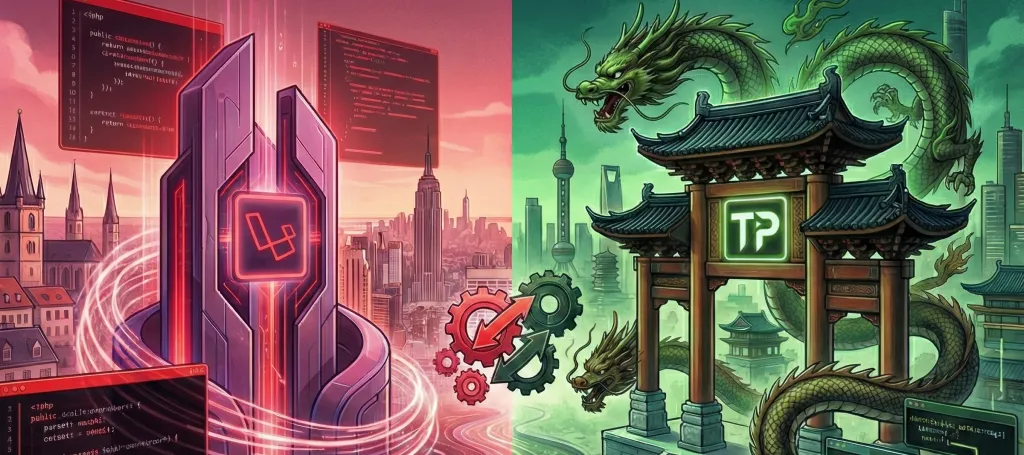
The PHP ecosystem is home to a vast array of frameworks.
Among these, Laravel stands as the most widely adopted PHP framework globally. In contrast, ThinkPHP, a framework originating from China, continues to be a preferred choice for a significant number of projects within the Chinese market.
* This information is current as of February 2026.
Table of Contents
Developed in 2011 by Taylor Otwell (Laravel LLC), Laravel is a PHP framework characterized by its elegant syntax. It provides a significant competitive advantage, particularly in the development of international projects.
The framework was designed with multilingual support in mind from the ground up. With extensive official documentation in English and active translations into many other languages, it enables seamless learning and information sharing across global development teams.
Technically, Laravel achieves exceptional flexibility and scalability through its rich feature set and a robust architecture centered on the Service Container. This makes it an ideal foundation for complex, large-scale projects, delivering high performance while ensuring maintainability and future growth.
Furthermore, Laravel boasts a strong track record of global adoption due to its comprehensive integration support for international cloud services and third-party APIs, such as AWS, Stripe, and Slack.
First released in 2006 (originally under the name FCS), ThinkPHP is a PHP framework designed to be simple, lightweight, and capable of high-speed execution.
The framework excels in its specialized support for the unique requirements of the Chinese development landscape. It offers extensive documentation tailored to domestic needs and boasts strong native integration with major Chinese services, including Alipay, WeChat, and Baidu.
Because ThinkPHP is fundamentally optimized for the Chinese market and Chinese-speaking environments, it remains a critical skill for developers working on domestic projects within China.
This section summarizes the primary differences between Laravel and ThinkPHP.
* This information is current as of January 2026. Specifications and features are subject to change in future updates.
| Item | Laravel | ThinkPHP | Remarks / Analysis |
| Official | |||
| Website URL | https://laravel.com | https://www.thinkphp.cn | – |
| Initial Release | 2011 | 2006 | ThinkPHP began development about five years earlier. |
| Development Entity | Taylor Otwell (Laravel LLC) and Developer Community | TopThink (Shanghai) Co., Ltd. and Developer Community | Both are open-source projects. |
| PHP Version (Latest) | PHP 8.2 – 8.4(Laravel 12.x) | PHP 8.0+(ThinkPHP 8.x) | Laravel typically has higher PHP version requirements. |
| Concepts | |||
| Core Philosophy | The Framework for Web Artisans | A Simple and Efficient Framework | Laravel prioritizes elegance. ThinkPHP focuses on pragmatism. |
| Target Audience | International Developer Community | Chinese Domestic Developer Community | Clear distinction in regional focus |
| Technical Features | |||
| Architecture | MVC and Service Container | MVC | Laravel offers a more modern architectural design |
| ORM(Object-Relational Mapping) | Eloquent ORM | ThinkORM Proprietary | Both frameworks provide powerful ORM capabilities |
| Template Engine | Blade | Proprietary Engine | Blade provides a more extensive feature set |
| API Development | RESTful and API Resources | RESTful Support | Laravel offers superior support for API resources |
| Real-time Features | Laravel Echo and WebSockets | Third-party Dependency | Laravel excels in native real-time capabilities |
| Developer Experience | |||
| Learning Curve | Systematic and gradual learning path | Lower barrier for Chinese speaking developers | Language dependency creates a significant divide |
| Documentation | English centered with extensive multilingual support | Focused primarily on Chinese | Laravel demonstrates much higher global accessibility |
| Debugging Tools | Rich ecosystem including Telescope and Horizon | Standard debugging capabilities | Laravel provides a more comprehensive diagnostic suite |
| CLI Functionality | Highly powerful Artisan CLI | Functional command line utilities | Artisan serves as a major competitive strength for Laravel |
| Ecosystem | |||
| Package Management | Primarily utilizes Composer and Packagist | Primarily utilizes Composer | Both frameworks share modern PHP development standards |
| Official Extensions | Rich integrations with international services | Focused on integrations with Chinese services | International standard versus China specialized model |
| Third-party Ecosystem | Active global package development | Active domestic community within China | Laravel maintains a significantly larger ecosystem scale |
| Development Environment | Laravel Sail・Valet・Homestead | Features a proprietary development server | Laravel offers a more diverse range of development environments |
| Performance | |||
| Startup Speed | Moderate due to extensive feature set | Relatively lightweight and fast | ThinkPHP holds an advantage in small to medium scale projects |
| Memory Usage | Higher and proportional to feature density | Relatively low | – |
| Scalability | Designed for large scale enterprise systems | Optimized for up to medium scale systems | Laravel architecture provides superior support for scaling |
| Market Alignment and Integration | |||
| International Service Integration | Official support for global services including AWS, Stripe, and Slack | Dependent on third-party community packages | Laravel offers superior capabilities for international connectivity |
| Chinese Service Integration | Requires third-party packages for localized services | Comprehensive native support for Alipay, WeChat, and Baidu | ThinkPHP maintains a dominant position within the Chinese market |
| Multilingual Support | Extensive support for languages worldwide out of the box | Provides standard internationalization features | Laravel is the preferred choice for cross-border global projects |
| Community | |||
| Geographic Distribution | Distributed worldwide across all regions | Primarily concentrated within Mainland China | – |
| Job Market Demand | High demand in the global employment market | Strong demand within the Chinese domestic market | Significant regional variations exist in professional opportunities |
| Conferences and Events | Major international events such as Laracon Worldwide | Events and developer summits hosted within China | – |
| Latest Industry Trends | |||
| Update Frequency | Semi-annual major releases | Consistent periodic updates | Laravel follows a highly predictable and clear release cycle |
| Modern Development Support | Advanced frontend integration with Inertia and Livewire | Incremental adoption of modern development features | Laravel leads in seamless synchronization between frontend and backend |
| Microservices | Comprehensive solutions including Lumen and Laravel Octane | Fundamental support for microservice structures | Laravel provides a more robust framework for high-performance microservices |

While ThinkPHP remains widely used for domestic development projects within China, recent years have seen a steady increase in the adoption of Laravel for new builds and international assignments.
For instance, in projects involving foreign-affiliated enterprises (such as Japanese firms) or cross-border e-commerce services, there is a high demand for global standards in design, maintainability, and scalability. Laravel is exceptionally well-suited for these requirements, offering robust coding conventions, advanced security architecture, comprehensive API development tools, and a vast package ecosystem.
Furthermore, when looking toward future overseas expansion or long-term scalability, Laravel often proves more sustainable for ongoing operations than ThinkPHP. Consequently, the number of engineers proficient in Laravel is rising annually, particularly among young developers in China and those with extensive experience in international project environments.
On the other hand, for projects exclusively targeting the Chinese market, the ThinkPHP framework remains a viable and effective choice.
Originally, ThinkPHP gained widespread adoption among small and medium-sized enterprises (SMEs) and development agencies across China due to its comprehensive Chinese-language documentation and low learning curve. Consequently, a vast number of websites and enterprise systems developed between the late 2000s and the 2010s were built using the ThinkPHP framework.
Even today, ThinkPHP is frequently utilized for domestic projects within China, as well as for the ongoing maintenance and refactoring of legacy systems.
The demand for Laravel in China is steadily increasing. For new development and international assignments, selecting Laravel is becoming the natural and standard choice.
However, for development specialized for the Chinese market or the maintenance of legacy systems, the technical expertise and insights surrounding ThinkPHP remain essential.
Ultimately, this is not a simple debate over which framework is “superior.” The key perspective is that the optimal framework changes based on the specific nature of the project and its future roadmap.
When undertaking system development in China, it is vital to clarify project requirements, evaluate the target market, and consider future scalability before selecting the most suitable framework for your needs.
For website creation, server construction/operation
▼ Company WeChat Official Account▼

▼ Contact person in charge WeChat ID ▼


 Follow us on WeChat
WeChat Official Account
Person in ChargeWeChat




 【2026】Public Holiday Calendar for China, Japan, and Singapore